

Igniting Professional Growth: A Call to Action
In an era where professional learning has often been limited to passive "sit and get" formats, it's time for a transformation. The Mightier app provides an innovative way to engage educators in a model of professional learning that is ongoing, supportive, and participatory. By embracing this tool, we can break free from outdated practices and empower teachers to actively shape their growth, with sustained support tailored to their specific challenges. This call-to-action is a step toward a more effective, relevant, and impactful professional learning experience for everyone involved.
Core Motivations: The Why
Standing in front of teachers during yet another mandatory professional development session, I saw it happen again—engaged educators slowly disconnecting as they sat through content that barely touched the realities of their classrooms. I couldn’t blame them. When professional learning is reduced to PowerPoint slides and compliance checkmarks, we’re not just failing our teachers—we’re failing our students, especially those who need us most.
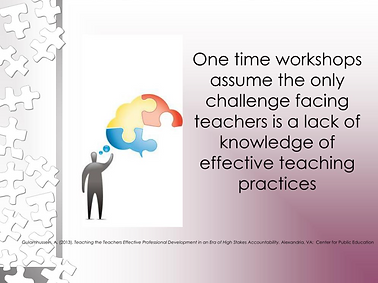
I've spent years seeing the gap between what research says works and what actually happens in professional learning. Gulamhussein’s research confirms what we already know—one-off workshops don’t move the needle on student outcomes. And TNTP’s The Mirage study revealed an even harsher reality: billions of dollars poured into professional development with little to show for it.
But we have the power to change this. The Mightier app isn’t just another tool—it’s a game-changer for students with autism and the educators who support them. By helping teachers develop emotional regulation strategies alongside their students, Mightier transforms the classroom experience. Instead of passively sitting through PD, educators engage in hands-on learning, practicing techniques that directly impact their students. They receive real-time feedback, build skills through ongoing support, and, most importantly, see their students thrive.
This isn’t just about making professional development better—it’s about changing lives. Without this shift, we risk leaving behind students who need structured, research-backed emotional regulation strategies to succeed. We risk losing teachers to burnout because they feel unprepared to meet the needs of neurodiverse learners. And we risk clinging to outdated PD models that do nothing to create real change.
Our students—especially those with autism—deserve more. Our teachers deserve real support. We can’t afford to wait. The time to transform professional learning is now.
My journey to revolutionize professional learning didn’t start in research papers—it started with family. My cousin, diagnosed with autism at a young age, struggled with emotional regulation in ways that impacted every part of his life. Watching him grow up, I often wondered: what if he had access to better tools to help him manage stress and frustration? Now, working with an autistic adult, I see firsthand how different her life could have been if she had learned emotional regulation strategies earlier. This isn’t just professional for me—it’s deeply personal.
That’s why I’m passionate about integrating the Mightier app into schools. This isn’t just another classroom tool; it’s a research-backed solution that helps students with autism build the emotional regulation skills they need to thrive. But for it to work, we need to rethink how we train teachers.
Traditional professional development simply doesn’t prepare teachers for the realities of supporting neurodiverse students. Research confirms this. The Mirage (Hill, 2015) exposed the billions spent on ineffective PD, while Goodwin (2015) highlighted the power of collaborative learning. Yet, we continue to rely on outdated training models that don’t translate into meaningful classroom change.
I’ve developed a professional learning framework that puts Mightier at the center of teacher growth. Rooted in the Standards for Professional Learning (2019), this model transforms training from passive lectures into active, continuous learning experiences. Teachers don’t just hear about strategies—they practice them, test them, and refine them in real-time, supported by a digital learning community. This collaborative approach ensures teachers feel confident integrating Mightier into their classrooms, creating an immediate impact for students with autism.
The stakes couldn’t be higher. Every day we delay this shift is another day students miss out on the support they need. In our district alone, we spend over 1,000 hours annually on professional development. Imagine the impact if those hours were dedicated to hands-on, personalized learning experiences that directly improved student outcomes.
This isn’t about theoretical change—it’s about real teachers, real classrooms, and real students. Our implementation plan includes clear success metrics: teacher engagement, classroom integration, and student progress. We’re ready to move beyond research and into action, ensuring that every child—especially those with autism—gets the support they deserve.
It’s time to transform professional learning. Not just because it’s better for teachers, but because it changes lives.
My How
In developing my professional learning initiative, I took a systematic approach to ensure both clarity and impact. The foundation of my project was built using Google Slides, which provided the perfect platform to organize and visualize my ideas for implementing Mightier in the classroom. To ensure my presentation met professional standards, I immersed myself in studying 5389 example pages, drawing insights from various presentation structures and content organization methods. I love that I can view others in the ADL programs how. Some of them are so detailed about the Screencastify and other applications to create amazing videos. I am honestly not quite there. I used Google Slides and my laptop camera. I then uploaded the video to you tube and embedded on my Wix website. I also utilized youtube videos to carry this out.
Collaboration played a crucial role in refining my approach. By reviewing my fellow students' submissions, I gained valuable perspectives on different ways to structure professional learning plans. This peer feedback process was invaluable in helping me shape my content to be more realistic and actionable, particularly for teachers who would be implementing Mightier in their classrooms. This was valuable because fellow students also have real life students and family that have autism.
To enhance my presentation skills, I turned to expert resources, particularly focusing on the "Presentation Zen Design" video. This resource transformed my understanding of effective presentation design, emphasizing the power of simplicity and visual impact. I applied these principles throughout my slides, creating minimalist layouts that communicate clearly without overwhelming the audience. The result was a polished, professional presentation that effectively conveys how Mightier can be integrated into classrooms through sustained teacher development. I do feel my speaker notes are a bit too detailed. I like the impact on my speaker notes.
Through this comprehensive development process, combining research, peer collaboration, and professional design principles, I've created a presentation that not only explains our professional learning initiative but does so in a way that engages and inspires action. The final product reflects my commitment to creating materials that will effectively support teachers in their journey to implement Mightier and improve emotional regulation support for their students. I am so excited for this to go into action!
Reference
Desimone, L. M. (2009). Improving impact studies of teachers’ professional development: Toward better conceptualizations and measures. Educational Researcher, 38(3), 181-199.
Fullan, M., & Hargreaves, A. (2016). Bringing the profession back in: Call to action. Learning Forward.
Gulamhussein, A. (2013). Teaching the teachers: Effective professional development in an era of high stakes accountability. Center for Public Education. Retrieved from http://www.centerforpubliceducation.org/system/files/2013-176_ProfessionalDevelopment.pdf
Guskey, T. R. (2002). Professional development and teacher change. Teachers and Teaching, 8(3), 381-391.
Image Citation:
Gulamhussein, A. (2013). Teaching the teachers: Effective professional development in an era of high stakes accountability [Cover image]. Center for Public Education. Retrieved from https://www.academia.edu/28440314/Teaching_Effective_Professional_Development_in_an_Era_of_High_Stakes_Accountability_READ_THE_REPORT_Center_for_Public_Education
Johnson, L. (2021). Teachers collaborating in a workshop [Photograph]. Education Weekly. https://educationweekly.com/images/collaboration
Math4Life. (2023). 5 Principles of Effective Professional Learning. Math4Life. Retrieved from https://www.math4life.org/learning-and-leading/5389-develop-effective-professional-learning/connecting-and-communicating-your-ideas
Mightier Team. (2022). *Mightier app interface showing emotional regulation tools* [Screenshot]. Mightier. https://mightier.com
NYSUT Education & Learning Trust. (2025). Autism training. NYSUT Education & Learning Trust. Retrieved from https://elt.nysut.org/professional-learning/autism-training
Organization for Autism Research. (2025). Understanding Autism: Online Presentations. Organization for Autism Research. Retrieved from https://researchautism.org/educators/curriculum-in-a-box/online-presentations/
Smith, J. (2022). Thank you slide with abstract background [Digital image]. Slideshare. https://www.slideshare.net/thankyouimage
Touch-type Read and Spell. (n.d.). Strategies for students with autism learning to read [Image]. Retrieved from https://www.readandspell.com